

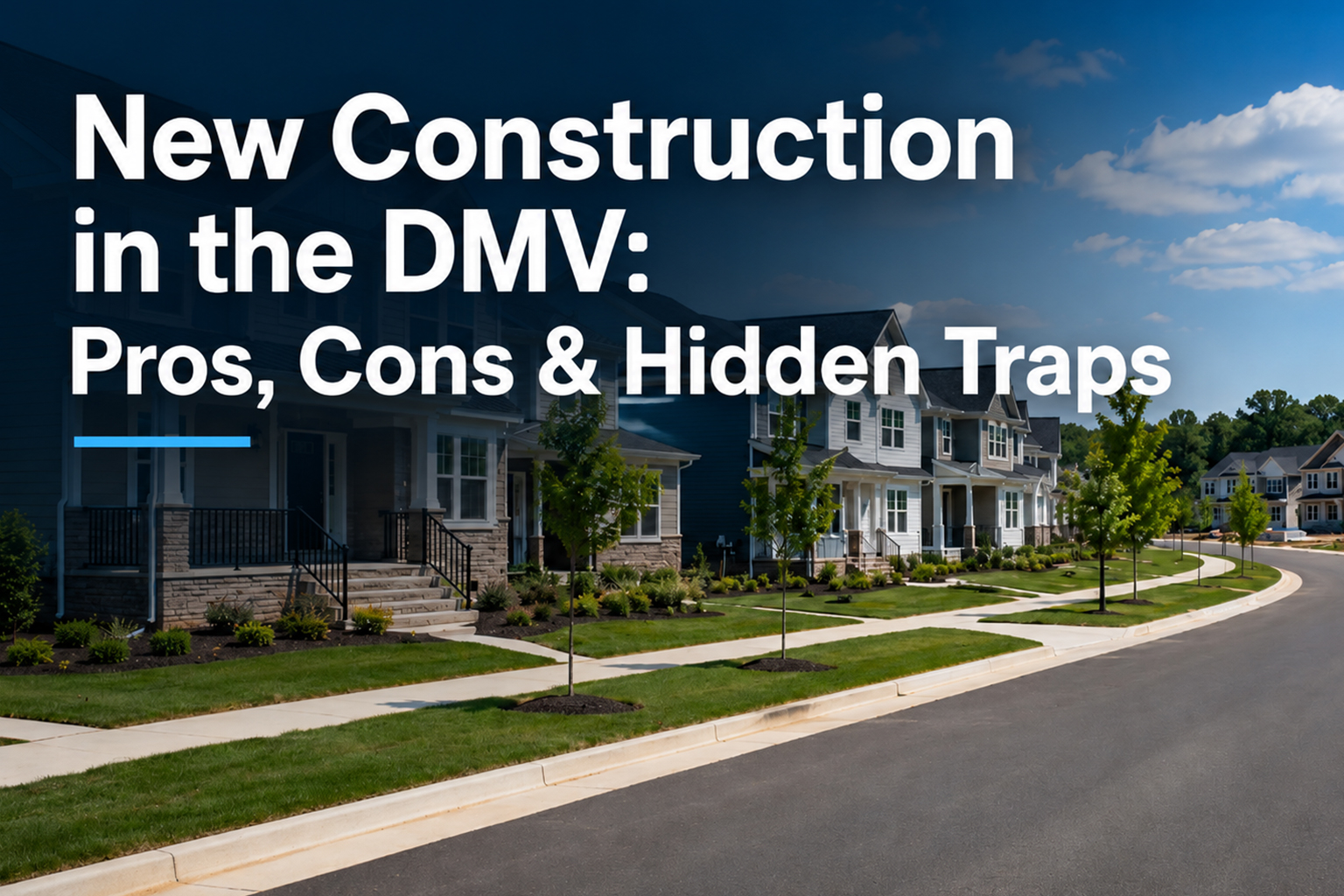
20 Jul Should You Buy New Construction in the DMV? Pros, Cons & Hidden Traps
New Construction in the DMV: Pros, Cons & Hidden Traps
Buying new construction in the DMV can be exciting. You get a modern floor plan, new appliances, updated building systems, and the possibility of selecting your own finishes. However, the advertised price may not include lot premiums, design upgrades, community fees, landscaping, or other expenses that significantly increase the final cost.
Before purchasing new construction in the DMV, buyers should carefully review the builder contract, financing incentives, inspection options, construction schedule, warranty coverage, and expected monthly expenses.
A beautifully decorated model home can make the decision feel easy. The real question is whether the finished home, total cost, location, and contract terms support your long-term goals.
Is New Construction in the DMV Right for You?
Newly built homes can be a strong option for buyers who want modern features, fewer immediate renovation projects, and the opportunity to personalize certain parts of the property.
However, new does not automatically mean affordable, problem-free, or low-maintenance.
New construction in the DMV may be a good fit when you
- Want a modern floor plan and updated home systems.
- Prefer fewer immediate remodeling projects.
- Have flexibility around your move-in date.
- Can afford upgrades without stretching your budget.
- Are prepared to hire an independent home inspector.
- Understand that the starting price may not be the final price.
- Have reviewed the builder’s contract and warranty carefully.
A resale home may be a better choice when you:
- Need to move by a firm date.
- Want an established neighborhood.
- Prefer mature landscaping and larger lots.
- Need more negotiating flexibility.
- Want to see exactly what the home and surrounding community look like.
- Prefer a location closer to an established metro station, employment center, school, or downtown area.
The right decision depends on more than whether the home is brand new. Your commute, monthly payment, future resale options, and lifestyle should carry more weight than the appearance of the model home.
What Counts as New Construction?
New construction generally falls into three main categories.
To-Be-Built Homes
With a to-be-built property, the buyer selects a homesite, floor plan, structural options, and finishes before construction begins.
This option usually offers the greatest amount of personalization. However, it also requires the longest timeline and creates more opportunities for construction delays, material substitutions, or budget increases.
Quick-Move-In or Spec Homes
A quick-move-in home has already been started or completed by the builder.
You may have limited ability to select finishes, but the move-in timeline is usually shorter. Buyers can also see more of the actual home instead of relying primarily on floor plans and renderings.
Builders may be more motivated to offer incentives on completed inventory, particularly when they are trying to close out a section or phase of a development.
New Condominiums and Townhomes
New condominiums and townhome developments are common throughout the DMV, especially in areas where land is expensive.
Buyers should evaluate both the home and the larger community structure. Review the association budget, monthly fees, parking arrangements, common areas, rental restrictions, warranties, future development phases, and responsibility for exterior maintenance.
Benefits of Buying New Construction in the DMV
One reason buyers consider new construction in the DMV is the opportunity to purchase a modern home with fewer age-related repair concerns during the early years of ownership.
That does not eliminate the need for careful due diligence, but it can offer several meaningful benefits.
You May Be Able to Personalize the Home
Depending on the construction stage, buyers may be able to choose the following:
- Flooring
- Cabinetry
- Countertops
- Fixtures
- Kitchen layouts
- Finished basements
- Additional bedrooms or bathrooms
- Home-office options
- Electrical upgrades
- Smart-home features
- Outdoor living spaces
Personalizing the home before move-in may reduce the need for immediate renovation.
The risk is that upgrades can become expensive quickly. The model home often contains premium finishes, enhanced lighting, upgraded flooring, designer paint, structural additions, and extensive landscaping that are not included in the advertised starting price.
Before making selections, ask the builder for an itemized price showing the cost of every upgrade.
Major Building Systems Are New
New homes typically include recently installed roofing, electrical systems, plumbing, heating and cooling equipment, appliances, windows, and insulation.
This may reduce the likelihood of replacing an aging roof, furnace, or water heater shortly after moving in.
However, new systems can still be installed incorrectly. Some construction problems are not visible during a casual walkthrough and may not appear until the buyer has lived in the home for several months.
A new home should still be inspected independently.
Modern Layouts May Fit Today’s Needs
Many new homes include features that appeal to current buyers, including:
- Open kitchen and living areas
- Larger kitchen islands
- Dedicated home offices
- Flexible loft spaces
- Walk-in closets
- Ensuite bathrooms
- More electrical outlets
- Energy-efficient windows and equipment
- Electric-vehicle charging preparation
- Multigenerational living options
These layouts may work well for buyers who work remotely, entertain regularly, or need flexible household space.
Still, a modern floor plan should not outweigh location, affordability, commute time, or future resale potential.
Builders May Offer Financial Incentives
Builders may advertise:
- Closing-cost assistance
- Mortgage-rate reductions
- Upgrade credits
- Design-center allowances
- Appliance packages
- Reduced lot premiums
These incentives can provide real value.
However, many offers require buyers to use the builder’s preferred lender or settlement provider. Buyers should compare the interest rate, annual percentage rate, lender fees, discount points, credits, cash needed at closing, and total loan cost.
The Consumer Financial Protection Bureau recommends comparing loan estimates from multiple lenders using similar loan terms. Lender credits can reduce upfront closing costs, but they may be connected to a higher interest rate.
Incentives can make new construction in the DMV more attractive, but buyers should evaluate the entire financial package rather than focusing only on the advertised credit.
Disadvantages of New Construction in the DMV
Despite its appeal, new construction in the DMV can involve higher final costs, longer timelines, and less certainty than many buyers initially expect.
The Base Price Is Rarely the Final Price
A builder may advertise a home as “starting from” a certain amount.
That price may exclude:
- Lot premiums
- Structural options
- Finished basements
- Decks or patios
- Upgraded kitchens
- Premium flooring
- Additional lighting
- Window treatments
- Landscaping
- Fencing
- Certain appliances
- Closing expenses
A home with a $700,000 base price can become significantly more expensive after the lot and upgrades are added.
Request a written estimate showing the complete price of the home as configured. Do not base your budget on the starting price shown in an advertisement.
Completion Dates Can Change
Construction schedules can be affected by:
- Permitting
- Municipal inspections
- Labor availability
- Material availability
- Weather
- Utility connections
- Design changes
- Local approvals
A projected delivery month may not be a guaranteed closing date.
Delays can create problems when the buyer must coordinate the sale of an existing home, a lease expiration, a mortgage-rate lock, temporary housing, school schedules, or moving services.
Review what the contract says about extensions, cancellation rights, delay notices, and temporary living expenses.
The Neighborhood May Be Unfinished
Your home may be complete while the surrounding community remains under construction.
Buyers may experience:
- Construction noise
- Dust and dirt
- Contractor traffic
- Incomplete sidewalks
- Temporary roads
- Limited landscaping
- Unfinished amenities
- Changing traffic patterns
- Future homes affecting views or privacy
Ask which amenities are guaranteed, which are proposed, when they are expected to open, and whether plans can change.
Renderings are useful marketing tools, but they are not always a promise of exactly what will be delivered.
New Developments May Have Smaller Lots
Land is expensive throughout much of Washington, D.C., Northern Virginia, and suburban Maryland.
Some new developments maximize density through smaller lots, narrow setbacks, townhomes, shared green spaces, or condominium-style ownership.
A new property may provide more interior living space but less yard space, privacy, parking, or distance from neighboring homes.
Review the actual site plan before selecting a homesite.
You May Compete With the Builder When Reselling
Buyers should consider how long the builder expects to remain active in the community.
Suppose you need to sell after two or three years while the builder is still offering brand-new homes nearby. Your resale property may compete against properties with new warranties, builder incentives, unused finishes, and customization options.
Ask how many development phases remain and how long additional construction is expected to continue.
Hidden Traps When Buying New Construction in the DMV
The most expensive risks are not always visible inside the model home.
Understanding the hidden traps associated with new construction in the DMV can help buyers protect their deposit, budget, and future resale value.
The Builder Contract May Favor the Builder
New-construction purchases usually use the builder’s own contract rather than the standard resale agreement commonly used in the local market.
The contract may address:
- Nonrefundable deposits
- Construction delays
- Material substitutions
- Financing deadlines
- Buyer-default penalties
- Appraisal shortages
- Inspection limitations
- Arbitration requirements
- Warranty procedures
- Changes to plans or specifications
- Restrictions on assigning the contract
Do not assume the contract provides the same buyer protections found in a typical resale transaction.
Have the agreement reviewed by an experienced real estate professional and, when appropriate, a qualified real estate attorney before signing.
Your Deposit May Be Difficult to Recover
A builder may require an initial deposit followed by additional payments for structural changes and design-center selections.
Some or all of the deposit may become nonrefundable.
Confirm the following in writing:
- The total deposit required
- When each payment is due
- Where the deposit will be held
- Whether upgrade deposits are refundable
- What happens if financing is denied
- What happens if the home does not appraise
- What happens if the builder misses the estimated completion date
- Which events allow the buyer to cancel
Verbal assurances from a sales representative should not replace written contract terms.
The Preferred-Lender Offer May Not Be the Best Deal
A builder may offer a large credit when the buyer uses its preferred lender.
The offer may be competitive, but buyers should compare it with outside financing options before making a decision.
Request loan estimates using the same purchase price, loan type, down payment, and rate-lock period. Compare the rate, points, lender fees, credits, monthly payment, and expected cash to close.
The CFPB explains that Loan Estimates are designed to help borrowers compare loan offers and costs across lenders.
A large closing-cost credit is not necessarily a true savings when the associated loan carries a higher interest rate or additional fees.
New Homes Still Need Independent Inspections
Some buyers assume a new home does not need an inspection because it has been reviewed by municipal building inspectors.
A municipal inspection and a buyer’s independent home inspection serve different purposes.
The CFPB recommends hiring an independent inspector who is accountable to the buyer and can provide an honest assessment of the property.
Independent inspections are especially important when purchasing new construction in the DMV, because defects may be hidden behind walls or may not become obvious until after closing.
Depending on the construction schedule and builder contract, consider the following inspections.
Pre-Drywall Inspection
This inspection occurs before insulation and drywall conceal the framing, wiring, plumbing, ductwork, and structural connections.
Pre-Settlement Inspection
This inspection evaluates the substantially completed home before closing and helps identify defects or incomplete items for the punch list.
Warranty Inspection
Buyers may also schedule an inspection before an important warranty deadline. This can help document developing problems while they may still be eligible for correction.
Possible concerns include:
- Improper grading or drainage
- Missing insulation
- Roof installation defects
- Plumbing leaks
- Electrical problems
- HVAC concerns
- Damaged finishes
- Incomplete sealing
- Doors or windows that do not operate properly
Brand new does not mean perfectly built.
Property Taxes and Community Charges May Be Underestimated
The first estimated monthly payment may not reflect the full future cost of the completed home.
Ask for estimates based on:
- The completed property’s expected assessed value
- Current local property-tax rates
- HOA or condominium fees
- Special district charges
- Trash or utility fees
- Stormwater charges
- Special assessments
- Water and sewer charges
- Planned association fee increases
Fairfax County states that real property is assessed at fair market value and that the assessed value forms the basis of the property-tax calculation.
Some Maryland developments may also carry deferred water or sewer charges commonly described as front-foot benefit charges. Montgomery County warns that these charges can create confusion for homeowners.
The monthly cost of new construction in the DMV may increase after the completed home is fully assessed and all community charges take effect.
Do not rely on a temporary land-only tax assessment or an incomplete estimate.
The Home May Not Appraise for the Contract Price
Builders may charge substantial amounts for premium lots, structural options, and design upgrades.
Those choices may be valuable to you without contributing the same amount to the appraised value.
Review the appraisal provision in the contract and determine:
- Whether there is an appraisal contingency
- Whether the buyer can renegotiate
- Whether the buyer can cancel
- Whether the deposit is refundable
- Whether the buyer must cover the appraisal shortage in cash
Do not assume the builder will reduce the price if the appraisal is lower than the contract amount.
Builder Warranties Have Limits
A builder warranty does not necessarily cover every problem in the way the buyer expects.
The warranty may contain:
- Reporting deadlines
- Different coverage periods
- Cosmetic exclusions
- Maintenance requirements
- Construction-tolerance standards
- Mandatory repair procedures
- Arbitration provisions
- Limits on certain damages
Read the warranty before closing. Keep copies of all documents, photographs, inspection reports, repair requests, and communications.
In Virginia, builders of certain new dwellings must disclose known material defects that would violate an applicable building code. This disclosure requirement does not replace the buyer’s own inspection and due diligence.
In Maryland, home builders generally must register with the state before entering into contracts with consumers for the construction or sale of new homes. Buyers can verify registration through the Maryland Attorney General’s Home Builder Registration Unit.
Visiting the Sales Center Without Representation
The representative working inside the builder’s sales center represents the builder’s interests.
Many builders also have procedures governing buyer-agent registration. Your agent may need to be identified during your first visit or initial online registration.
Before visiting a new-home community, consider speaking with your own real estate professional.
A buyer’s agent can help you:
- Compare builder pricing with resale homes
- Evaluate lot premiums
- Review the site plan
- Identify potentially negotiable incentives
- Coordinate independent inspections
- Track contract deadlines
- Compare financing offers
- Evaluate upgrade value
- Prepare for the final walkthrough
Buyer-agent compensation and builder registration policies vary. Confirm the arrangement before entering into a representation or purchase agreement.
Questions to Ask Before Buying New Construction in the DMV
Before committing to new construction in the DMV, ask the builder for written answers about pricing, inspections, deposits, warranties, taxes, amenities, and completion dates.
Use this checklist before signing:
- What is included in the advertised base price?
- What features shown in the model home are upgrades?
- Is there a premium for the selected lot?
- What is the estimated all-in purchase price?
- How much deposit is required?
- Which parts of the deposit are refundable?
- Can I use an independent home inspector?
- Is a pre-drywall inspection permitted?
- What happens if construction is delayed?
- What happens if the home does not appraise?
- Can the builder substitute materials or finishes?
- Which warranties are included?
- How are warranty claims submitted?
- What are the projected property taxes after completion?
- Are there HOA or condominium fees?
- Are there special district or development charges?
- Are there deferred water or sewer charges?
- Which amenities are guaranteed?
- How many future construction phases are planned?
- Are rental restrictions expected?
- Who maintains the roads and common areas?
- What parking is included?
- What internet and utility services are available?
- Which incentives require the preferred lender?
- Are incentives available when using an outside lender?
Get important answers in writing before relying on them.
New Construction in the DMV vs. Resale Homes
When comparing new construction in the DMV with resale homes, consider more than age and appearance.
New Construction May Be Better When:
- You want modern finishes and layouts.
- You prefer fewer immediate renovations.
- You want some ability to select finishes.
- You have flexibility around the delivery date.
- You are comfortable living near ongoing development.
- You can afford the full price after upgrades.
A Resale Home May Be Better When:
- You want an established neighborhood.
- You prefer mature trees and landscaping.
- You need a predictable closing date.
- You want to inspect the complete home immediately.
- You prefer a larger lot or more privacy.
- You want more information about neighborhood history.
- You prefer a location where little undeveloped land remains.
A resale home may require updates, but it also allows you to evaluate the property, street, landscaping, traffic, views, and surrounding homes as they exist today.
The Bottom Line on New Construction in the DMV
Buying new construction in the DMV can be a smart decision when the home, location, contract terms, and total costs support your long-term goals.
However, buyers should not make the decision based only on an impressive model home, an advertised starting price, or a large builder incentive.
Evaluate the:
- Final purchase price
- Lot premium
- Builder contract
- Deposit exposure
- Financing terms
- Property taxes
- Association fees
- Inspection rights
- Warranty coverage
- Development timeline
- Commute
- Future resale competition
The best new-construction purchase is not necessarily the property with the largest incentive or most luxurious model.
It is the home that remains affordable, practical, and valuable after every expense and risk has been considered.
Thinking About Buying a New-Construction Home?
Before visiting a sales center or signing a builder contract, get experienced local representation on your side.
Jean Aboi can help you compare new construction and resale opportunities throughout Washington, D.C., Maryland, and Northern Virginia.
Get guidance evaluating builders, incentives, homesites, contracts, inspections, financing options, and total ownership costs.
Call Jean Aboi at 703-400-9633 to schedule a private DMV homebuyer consultation.
Frequently Asked Questions
Is New Construction in the DMV More Expensive Than a Resale Home?
It can be.
The advertised starting price may exclude the lot premium, structural additions, upgraded finishes, window treatments, landscaping, certain appliances, and community charges.
Always compare the builder’s complete itemized price with similar resale homes in the area.
Do I Need an Inspection for New Construction in the DMV?
Yes.
An independent inspection can identify defects, safety concerns, incomplete work, or installation problems that may not be obvious during the builder’s walkthrough.
Depending on the construction stage, consider pre-drywall, pre-settlement, and warranty inspections.
Can I Negotiate With a New-Construction Builder?
Possibly.
Builders may be more willing to negotiate through financing incentives, upgrade credits, closing-cost assistance, lot premiums, or completed-home pricing than through a direct reduction in the base price.
Negotiability depends on demand, inventory, development phase, and the builder’s sales goals.
Should I Use the Builder’s Preferred Lender?
Compare the preferred lender’s loan estimate with offers from outside lenders.
Review the interest rate, APR, discount points, lender fees, credits, monthly payment, and cash needed at closing.
Do not choose a lender based only on the size of the advertised builder credit.
Should I Bring an Agent When Visiting a Model Home?
It is wise to arrange your own representation before visiting.
Some builders require the buyer’s agent to be identified during the first visit or initial registration. Confirm the builder’s policy before touring.
Can Construction Delays Affect My Mortgage?
Yes.
A delay may affect your rate lock, temporary housing arrangements, moving schedule, lease expiration, or the sale of your current home.
Ask your lender about rate-lock extensions and review the builder contract for delay provisions.
Are Builder Warranties Enough to Protect Buyers?
A warranty can provide important protection, but it has limits.
Review the coverage periods, exclusions, reporting deadlines, maintenance requirements, repair procedures, and dispute-resolution provisions before closing.
What Is the Biggest Hidden Cost of a New Home?
There is no single hidden cost for every property.
Common surprises include lot premiums, design upgrades, higher completed-home property taxes, association fees, landscaping, window treatments, fencing, appliances, and special community charges.
Ask for a complete written estimate before finalizing your budget.
This article is provided for general educational purposes and should not be treated as legal, tax, lending, engineering, or home-inspection advice.
No Comments